Category: New Believers

  • Breaking Down Walls

    The weather was pleasant enough recently that I got out on my e-bike and pedaled. (Yes, I pedal. I use an assist of 1 or nothing when it’s relatively flat, and the 2 prevents the hip pain that comes from leaning into hill-climbs or wind.)  I cycled past the stands of trees, the fields of corn and soybeans, and the homes spread out along the country road. It was peaceful, with only the songs of birds breaking the silence.

    Most of this summer has been oppressively hot—more so than usual for southwestern Illinois. It has kept me inside. I hadn’t been getting out of the house for nonessential things, like my normal enjoyment of the outdoors.

    I had been feeling almost depressed, closed in by the walls of my home that God, in His kind provision, had figuratively removed through the perfect weather on that day.

    It reminded me of other instances when God removed walls. The destruction of Jericho in Joshua 6 tells the story, and like so much of the Bible, when we relate the stories to our own Christian lives, our eyes open to great life lessons.

    The lesson in Joshua 6 is that God eliminates walls when we humbly obey Him. And in a metaphorical way, He does so in the New Testament.

    Leading the Israelites into the Promised Land, Joshua trusted God and took direction from Him. Every town in the land they were about to occupy was full of paganism, idolatry, and wickedness, so everything in them had to be destroyed completely. This was necessary to avoid the contamination and temptation of sinful cultures.

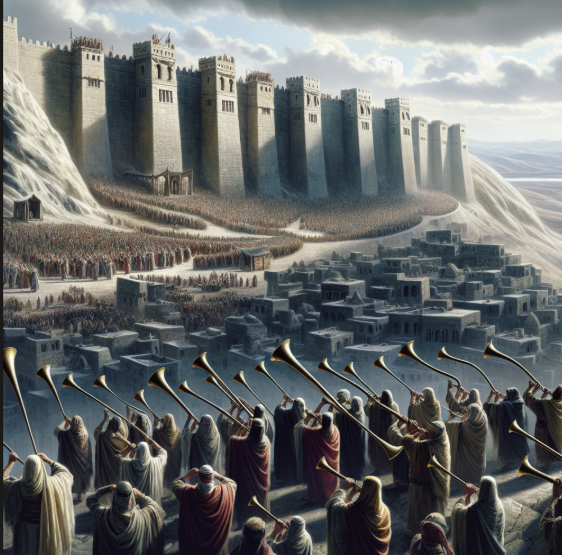
    The first town was Jericho, which was a fortress considered to be impenetrable. The walls stood 25 feet high and 20 feet thick in places. By God’s miraculous power and the Israelites’ obedience of God’s specific instructions, the walls of Jericho were destroyed.

    Joshua, his armed men, and the priests marched around the city once for each of six days. Some of the priests carried the Ark of the Covenant, while seven priests walking around it each had a trumpet that they blew as they marched.

    On the seventh day, they marched around Jericho seven times, blowing the trumpets, and at the last, long blast:

    Joshua 6:20 ‘When the trumpets sounded, the army shouted, and at the sound of the trumpet, when the men gave a loud shout, the wall collapsed; so everyone charged straight in, and they took the city. ‘

    For the complete story of Jericho’s destruction:

    Joshua 6 | NIV Bible – Bible App
    Every living thing was destroyed, but a woman named Rahab was saved, along with her family.

    We read in Joshua 2 that Joshua had sent two of his men to scope out Jericho before the plan to enter it was implemented. These men stayed with Rahab, a prostitute whose house was in a strategic location in the wall of the city. When some men of Jericho came looking to kill them, she hid the spies and sent the pursuers in the wrong direction. Rahab had heard of God’s power, and she had enough reverence to help Joshua’s men and to ask for God’s kindness:

    Joshua 2:11-13  ‘When we heard of it (God’s power), our hearts melted in fear and everyone’s courage failed because of you, for the Lord your God is God in heaven above and on the earth below. “Now then, please swear to me by the Lord that you will show kindness to my family, because I have shown kindness to you. Give me a sure sign that you will spare the lives of my father and mother, my brothers and sisters, and all who belong to them—and that you will save us from death.” ‘

    Rahab’s full story:

    Joshua 2 | NIV Bible – Bible App.

    Hebrews 11:31 “By faith the prostitute Rahab, because she welcomed the spies, was not killed with those who were disobedient.

    Rahab became an ancestor of Jesus!

    A Lesson:

    There has always been a wall that separates God’s presence from people. It is not made of stone or wood, but of sin. He loves each of us very dearly, and He wants us to know Him and feel Him near both on earth and in Heaven, so God made a way to remove the wall. He sacrificed His Son on the cross to pay the debt for our sins. Our “shout”, our “trumpet blast”, is admitting that we have sinned, turning away from it, and declaring Jesus as our Lord and Savior. Like Rahab, we can be saved.

    John 6:23 For the wages of sin is death, but the gift of God is eternal life in Christ Jesus our Lord.

    John 3:16 For God so loved the world that he gave his one and only Son, that      whoever believes in him shall not perish but have eternal life.

    Romans 10:9 If you declare with your mouth, “Jesus is Lord,” and believe in your heart that God raised him from the dead, you will be saved.

    We know there are other types of walls–barriers between ourselves and what is good–including pride, selfishness, comfort, and fear. I pray that we all look to God to destroy our walls.

  • The Edmund Fitzgerald Shipwreck: A Timeline and Eternal Lesson

    It was fifty years ago, but I remember it well. I am one of the 29 men aboard the SS Edmund Fitzgerald. It is November 10, 1975. (I am a fictional representation of any man who lost his life in the wreck of the largest freighter in the Great Lakes.)

    November 9, 1975

     At 2:20 pm, we depart from Superior, Wisconsin with 26,116 tons of iron ore. Nine minutes later, gale warnings are issued.

    November 10, 1975

    My captain, Ernest McSorley, began communicating yesterday with another ship on a similar course: the SS Arthur M. Anderson, captained by Jesse Cooper. The Anderson trails us by around 16, and later 10, miles.  Along the way, they talk about the dangerous weather and how to navigate their course to keep their ship and crew safe.

    3:30 pm: Our captain reports some damage, including topside, and he has the pumps going for our “Mighty Fitz”.

     4:30 pm: The beacon and light at Whitefish Point in Michigan are reported to out of operation.

     4:39 pm: The National Weather Service predicts winds gusting to 60 knots and waves 8 to 16 feet.

     6 pm: The Anderson is struck by waves of over 25 feet. It sustained damage but was okay.

    7:10 pm: The two captains are communicating about navigation. My ship has lost both radars and has a bad tilt. The 22-foot waves are pouring over the deck.

     Captain Cooper hears the last words that my captain will ever speak: “We are holding our own.”

     As dread fills my heart that I will be drowning, I think about what I heard from a Christian friend whose invitations to church I had always rejected. He had told me that we are all sinners. Sin separates us from God, so we can never be in His presence (in Heaven) until our sin is forgiven, redeemed, washed away. God is so loving and merciful that He sent His Son, Jesus, to die a painful death on the cross to redeem us of sin. It is a free gift, not born of works, but we must willingly humble ourselves and accept it.

     Water coming in from the cargo hold pools around my feet. I become unbalanced as the ship lists–tilts to one side.

    I call out to God, and I mean it: “I am a sinner in need of forgiveness. I believe that Jesus is Your Son, He died and rose again, and I receive Him as my Lord and Savior.”

    A sense of love and peace begin to reduce my fear.

     7:15 pm:  Near Whitefish Point in Lake Superior, my ship disappears from the radar of the Anderson. More than an hour later, the Coast Guard begins to search.

     7:55 pm: The Anderson tells the Coast Guard they have lost visual and radar sight of the Edmund Fitzgerald. It is later found in two pieces.

    A Beautiful Place for Me. And For You?

     Like all of the good, hard-working men, I drowned. Only my body was left, like an empty wrapper with no substance, but I found myself separated from it, in a place of beauty and peace. I came to be with Jesus, with God, a fulfillment of the promise of an eternity in Heaven for those of us who accept salvation through Jesus, even in our final moments.

    I am grateful to God that I had just enough time to secure my eternal life. And when I think about my life on the earth, I wonder how much more joyful and peaceful it would have been if I had put aside my pride or my schedule and gone to church with that Christian friend—and humbled myself enough to realize that Jesus is “the way, the truth, and the life; no one comes to the Father except through (Him)” (John 14:6).

     I also wonder, though I don’t despair–because there is no despair where I am now–what if I had died so suddenly that I had no time to reconcile with God? I would be suffering eternally, separated from hope.

     If you do not call Jesus your Lord and Savior, I urge you to think about my* experience. You never know when time will run out.

    *This could have been the experience of one or more of the crew on the doomed freighter. I (blog author) used creative license for an illustrative scenario that I could imagine as I listened to Gordon Lightfoot’s song and did some research.

     Scripture references:

    John 14:6

    Romans 3:23

    Romans 6:23

    Romans 10:9

    John 3:16

    Ephesians 2:8-9

    Edmund Fitzgerald Timeline — S.S. Edmund Fitzgerald Online

    Audio recording of the Anderson communicating with the Coast Guard:

    Gordon Lightfoot’s song:

    How the song came to be and how it became a cultural phenomenon:

    Gordon Lightfoot’s Song: How it became a cultural phenomenon